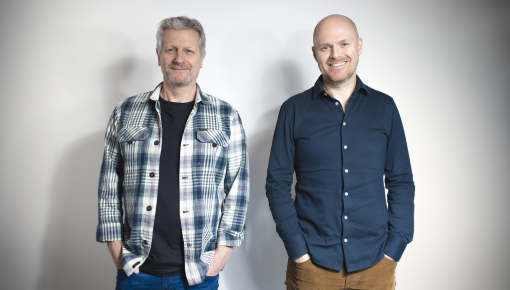
Amsterdam and US-based Qindle balances on the axis of consultancy and creative agency. They are both thinkers and doers. They have, among other things, a strong focus on tech and are happy to be seen in the boardrooms of Big Tech. The Qindle formula works. Founders Taco Schmidt and Ype Jorna update us on the current business-to-business perspective. ‘Our creativity is ideally suited to be used more strategically to solve complex problems and issues.’
Business to Business communication suffers from the image of being boring. How do you guys see that?
Taco Schmidt: ‘Business to business is very specific and targeted and still often lacks the ‘sexy’ image that the general public does have. It is generally not a communication you see on TV and it is precisely this visibility with the general public that the profession still finds very attractive.’
So then, this perceived dullness is mainly about the vanity of the profession? Seeing and being seen?
With a grin: ‘You said it!
80% of our customers are business-to-business. But with us, at the same time, a lot is also made from the Business to Consumer perspective. Logical because with a number of our customers, the products also end up with consumers.’
Intel inside
As an example, Taco and Ype give the Intel chip of which everyone has one or more in their devices. The sticker “Intel Inside”; who doesn’t know it?
‘Before the chips end up in consumers’ laptops, there are a
number of links in between. Think, for example, of the maker of the laptops. Now you can base your story on that, but you can also make a story about what that chip delivers to the end consumer. By doing so, you pull the product out of the trans-sectional and make your product more relevant. It strengthens your own position and at the same time the relationship between client and business becomes much stronger.’
B2B brands are often huge in size and impact within their industry, and that while consumer brands often seem bigger because of their visibility and cultural presence, the duo argues: ‘In addition, you can go deeper. That’s why the B2B perspective suits us better. We are always looking for complexity. In the consumer market, the complexity you deal with as an agency is often less, while our creativity is perfectly suited to be used more strategically and to solve complex problems and issues. That role suits us and that is what our team is made up for.’
Seeing connections
Business to Business is a broad concept and I can imagine that you therefore have a focus on specific sub-areas.
Taco: ‘Yes, that’s right! We have four focus areas in which we excel: semiconductor, health-pharma, AI, and consumer products with a strong focus on innovation processes. Because we employ consultants and strategists in addition to creatives, we can very quickly immerse ourselves in our clients’ subject matter. In recent years, we have built up more and more expertise and knowledge in the various sub-areas in which we operate.’
The four markets primarily served by Qindle may seem very different at first glance, but on closer inspection this is not so different, according to Taco and Ype.
Taco: ‘The biggest common denominator is innovation. Creatives and strategists can work very well with that. We approach innovation from the perspective of ‘systemic innovation’ or systemic innovation, in which we don’t focus on improving one product, service or organisational unit, but instead revolve around changing underlying structures, relationships or behavioural patterns that make up the whole. This is how we create a foundation for sustainable and scalable progress.
Innovation is also about realising new ideas in a market. This includes horizontally connecting the different departments or silos in a company. We help pull innovation through the company’s silos. If you don’t, new ideas remain nothing more than new ideas. Because we involve people from the different disciplines or pillars of the company, you immediately create added value.’
Ype adds: ‘Creatives are very good at seeing and making connections and then translating them into relevant, creative solutions.’

Countercyclical growth
Many agencies are currently experiencing a period of slower growth, if not Qindle. ‘Our growth is almost counter-cyclical. This is because we see our creativity as a systemic solution provider.
What sets us apart from many other agencies is that we can do strategic analysis while also bringing the creative solution. So the added value is in the connections we can make. We call that creative intelligence, where we can superimpose the analytical brain and creative brain, so to speak.’
Speaking the same language
How do you explain the Qindle proposition to a potential client?
‘We understand the business and the problem very quickly and therefore the demand. Because we have both consultants (analysis, ed.) and creatives (translation, ed.) in-house, we can actually put our analysis to work. We bring “direction” and we bring “action”. For many clients, this is a relief. An example: Quantinuum is a company that grew out of the University of Cambridge, among others. We started from the scientific perspective, quantum physics, and then made a strategic translation to communication in which the narrative is visually reinforced. Especially since that translation is not among their own skills, our input was a breath of fresh air for these scientists.
So we always start from the same language as the client. Not all agencies are equally strong at that. But for the CEO who wants to put business strategy in a broader context, that skill is essential. As a result, Qindle, for example, is very good at making technology tangible.’
Growth prospects
What do you expect for Qindle in 2026?
‘We will grow Qindle to around 30 people. For this, we also need the additional management layer we created two years ago.
Our revenue and growth currently come from three pillars:
1. The ventures proposition set up in 2022. The percentage of revenue generated from it is growing steadily.
2. Knowing where our added value (systemic innovation) lies, Qindle’s customer base is growing faster than before.
3. A large proportion of our customers are in the US and the domains we have built there we want to anchor here. We are now going to apply that knowledge and expertise more in Europe.’
At the same time, Qindle will also remain active in the US itself, Ype and Taco tell us. Ype: ‘There is structurally more money available in the US to achieve new things. There is always innovation budget available there, whereas in Europe you first have to build a huge case. The pace of innovation between Europe and the US is incredibly different. The cultural difference is very big. The thoughtfulness we have in Europe is good, but a bit more action, less talk wouldn’t hurt. Taco: ‘If you combine the people-oriented nature of Europe with the clout of the US, you have the best of both worlds. It’s all about balance.’
Open mind
As we conclude our conversation, Ype muses: ‘It’s wonderful to continue developing Qindle. We don’t want to get stuck in that one skillset, but always look at the world with an open mind and ask ourselves whether what we are doing is still relevant. If it doesn’t feel so, we need to get going and innovate. We have
found that renewal in systems thinking over the past two years.’